
An Interview with Svāmī Dayānanda Saraswati
(Source | KYM- Darśanam, May 1994, Vol. 3, No. 1 – An Interview by Śrī TKV Desikachar)
“Manager, manage thyself,” is the message the revered Svāmī-ji gives us. The means to this self-management is meditation. He explains to us what constitutes meditation, the preparations that must precede it and some of the reasons for the inability to meditate. He dispels the notions that persons who meditate become less concerned about society and shows the opposite is really the case.
Many management books extol the value of meditation and value-based business. Can managers and businessmen be helped by meditation? Can meditation help them develop the right values?
We must remember that a manager is a human being. However great the business empire he may be running, he is first and foremost a human being. As a human being he has a free will and is a self-conscious person. He cannot be expected to behave in a predetermined and mechanical manner all the time. He is in constant interaction with the world and is in a dynamic relationship with it. As the variables in this relationship are many and as all these variables are always changing, the relationship is almost always in a state of flux. Conflicts and problems are always present due to the difference between his apprehension of the existing situation and the reality. These problems and conflicts are part of every individual and need to be addressed and resolved to function effectively.
The manager first must find himself. This is the first step to being a good manager. A good manager needs to be calm and relaxed in all situations. If he allows himself to get agitated in difficult situations, then it is the situation which is managing him rather than him managing the situation. He must also be in control of his emotions. If he is not, his thoughts will not be clear and logical and his decision-making will be affected. Further, a manager who is emotional can be manipulated by others. He will lose the respect of his colleagues and be ineffective as a manager.
Meditation is the key to self-management. Through meditation, an individual will be more together as a person and this is the foundation to managing activity and relationships. Everyone who practices meditation will see the results in day-to-day living. Managers, will therefore most certainly be helped by meditation.
Through meditation, a person becomes relaxed, more in control of himself and better balanced. This leads to the development of right values. A person’s values are acquired over a period of time and are an integral part of that person. These values are constantly reinforced by the person’s day-to-day actions, which in turn are a reflection of his value system. Because they are deep rooted and difficult to change.
A change in values requires a personal transformation. Though meditation helps in bringing this about, it is most easily brought about through a teacher, who is experienced, knowledgeable and compassionate. Through constant instruction in various aspects of the teaching, the teacher comes to know the person with all his doubts, fears and prejudices. He chooses the teaching and the method best suited to a person and over a period of time brings about a cognitive change and through it, a complete reorientation. Meditation will form an important part of this transformation but it is the teacher and the entire process which brings it about most effectively.
Lord Kṛṣṇa, when instructing Arjuna, did not stop after teaching him meditation but continued with all the aspects till the change was brought about.
Many people find it difficult to meditate. Why is this so?
It is necessary to first understand what meditation involves before analysing the reasons for the difficulty to meditate.
There are two components to meditation – the meditator and the meditation itself. If the mediator is full of conflict and unconscious mental activity, then in this condition, meditation may even be harmful. This mental activity must first be processed and set to rest and only then should meditation begin. The sixth chapter of the Bhagavadgītā which deals with meditation has very little to say on meditation itself but has a lot to say about the meditator.
It talks of the person and the attitude. The person must be able to sit and relax. The first Aṅga of meditation is relaxation. The place where the meditation is done, the prevailing environment, the seat, the posture and the relaxedness in that posture are all important factors which contribute to the quality of meditation.
The second Aṅga is the object of meditation. The object of the mental activity is “Saguṇa Brahma,” who is Īśvara. This visualisation of Īśvara could be either with or without form. It is important that this be the object of meditation or else even worrying single-mindedly about a problem could be called meditation.
The ways to this mental activity focused on Īśvara are many. It could be through Pūja. This is worship involving materials, physical actions and prayer, all of which lead to the focus of the mind on Īśvara. Another way is through the oral recitation of a Mantra or the singing of devotional songs. Then we have Dhyāna. This involves mental recitation of the name of God, a prayer or a Mantra. Any of these methods can be adopted depending on the preference of the meditator.
In our discussion on meditation, we are dealing with Dhyāna which is mental focus alone. Where a person chooses this form of meditation, it is very important that he has prepared himself for this. The preparation must be both physical and mental.
In addition to the general preparations, it is important that the person is prepared for the specific mental activity so that it leads him to focus the mind on Īśvara. If the object of mental focus given to the meditator has no meaning for him, then he will not be able to meditate. This could be one reason for the difficulty to meditate.
Another reason for difficulty with meditation is that people try to invoke Īśvara in their minds while simultaneously performing the chosen mental activity. The mind cannot handle two conscious thoughts at the same time. When the person tries to do this, he does not succeed, he gets frustrated, anxious and thinks that there is something wrong with his mind. But actually, they are trying to do something that cannot be done. The right method would be to prepare for the meditation by developing a prior association of the object of focus with Īśvara. Once this has been internalised, then whenever that object comes to the mind, Īśvara is also present. This will be the same as when saying the word “apple,” the person cannot but also think of an apple.
There is one more aspect to meditation. The very definition of meditation is to bring the mind back to the object of focus.
yato-yato niścarati manaś cancalam asthiram tatas-tato niyamyai’tad ātmanyeva vaśam nayet
Bhagavadgītā – 6.26
Once this is understood, then a person cannot complain, saying that meditation is not possible because the mind keeps going away. To keep going away is the very nature of the mind and to bring back the mind is the purpose of meditation.
Before sitting down for meditation, a person must suggest to himself that every time the mind moves away, he will bring it back. This has to be said in so many words. Being aware of this aspect of the mind in a general way is not sufficient. It must be specifically said to oneself each time the person sits down to meditate. If this is not done, there will be a tendency to get frustrated and give up the whole exercise.
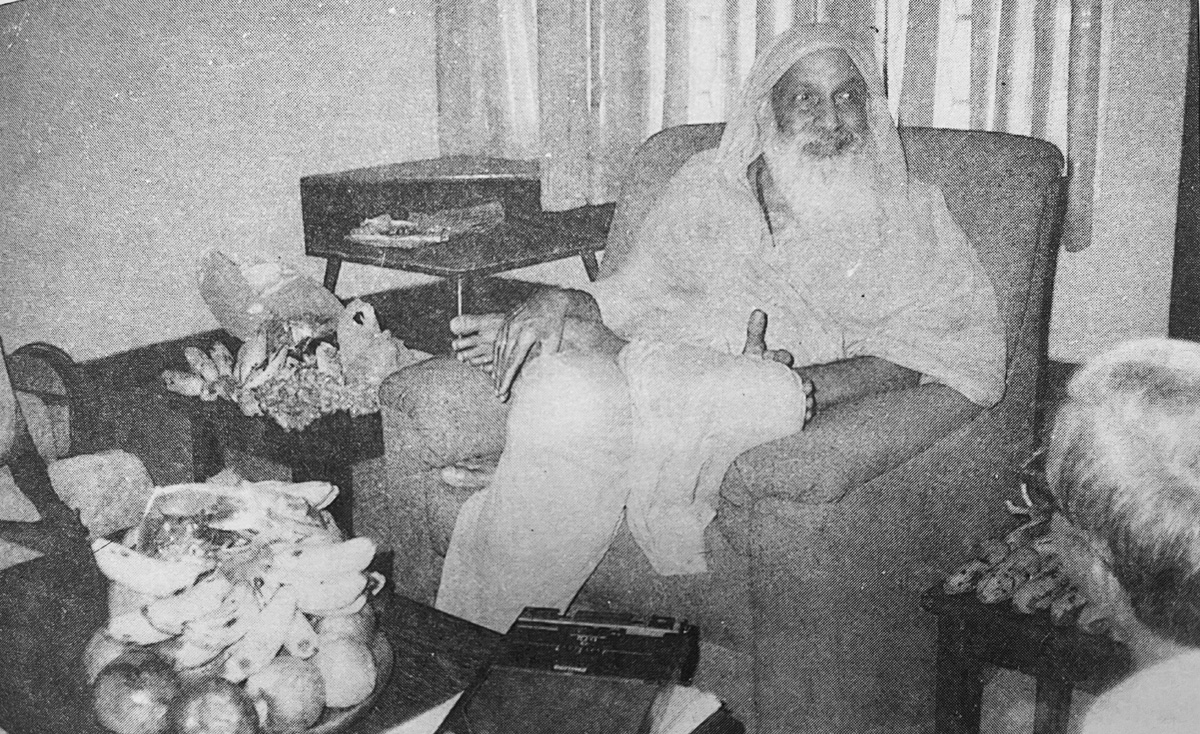
In the Photograph: Svāmī Dayānanda Saraswati and Śrī TKV Desikachar
How should people from other cultures approach meditation?
The nature of the mind is the same for all people irrespective of the culture to which they belong. They too must go through the required preparation, choose an object of focus that is meaningful to them, establish a prior association of that object with Īśvara and consciously determine to keep bringing the mind back to the object. The worship, the prayer and the form of Īśvara they choose could be appropriate to their culture. This would help make the activity meaningful.
If they are unable to carry out all the necessary preparations, they should not begin meditation but should stop with relaxation. For an agitated condition, relaxation itself will help the person be more in control of himself. It goes without saying that this applies to all agitated minds, whatever the culture.
People nowadays and especially managers are very busy. They are always complaining about lack of time. How should these busy people approach meditation?
First, they must relax. They can then start on some simple practice like watching the movement of the breath. The best thing these people can do is to find a teacher and be directed by him. As explained earlier, the teacher will be able to direct them in the path most appropriate to their condition. Through this, their progress will be much faster than what they would achieve on their own.
There is the notion that persons who meditate become more self-centered and less concerned about society.
It is arrogant to think that one can take care of others or the society. Our primary duty is to manage ourselves well. In this process, we develop sensitivity. The more sensitive we become, the more we empathise with another’s condition. When we see another person in pain, we are also affected. And our efforts to help that other person are also our efforts to help ourselves.
A person who is unmoved by the suffering of others is not human. Since meditation increases sensitivity and therefore the feeling for another’s pain, in actuality, a person who meditates will be more concerned about others.
Further, the whole purpose of meditation is to loosen the hold of the self and place Īśvara in our center.
—
Svāmī Dayānanda Saraswati was a spiritual leader and social reformer with disciples all over the world. His discourses were widely attended and appreciated for their clarity and simplicity.